Leg 02of a walk with no known length
One Summer
They weren't wrong about the machine. They were wrong about which part was hard — and you can see it in what they left off the list.
Written 31 August 2026
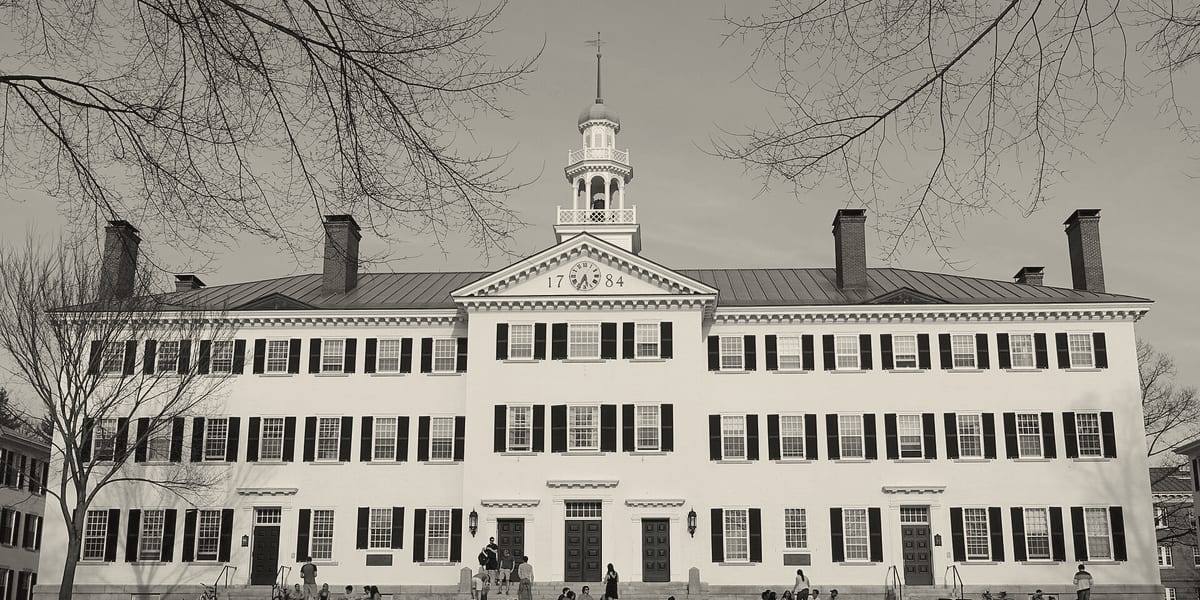
Seventy-one years ago today, four men signed a document.
J. McCarthy of Dartmouth College. M. L. Minsky of Harvard. N. Rochester of I.B.M. C. E. Shannon of Bell Telephone Laboratories. Four pages, dated the thirty-first of August, 1955.
It opens like this:
We propose that a 2 month, 10 man study of artificial intelligence be carried out during the summer of 1956 at Dartmouth College in Hanover, New Hampshire.
That sentence is the first time the phrase artificial intelligence appears in print anywhere. It is also, read seventy years later, one of the most confident estimates anybody has ever written down. Two months. Ten people.
I ended the last leg calling that story too straight — every step in it true, the line drawn between them far too neat — and said the question worth having was not that they were wrong but why. The why is in this document. Not in anything it got wrong about machines, but in what it quietly assumed about the problem.
They were asking the Rockefeller Foundation for the money, and the budget is in the document too: $1,200 for each faculty-level participant not already being paid by his own institution. That is what the founding of the field cost, as a line item.
What they actually claimed
It is worth being precise about the claim, because the popular version — they thought they’d solve AI in a summer — is a caricature, and the real thing is more interesting.
The conjecture they proposed to work from:
every aspect of learning or any other feature of intelligence can in principle be so precisely described that a machine can be made to simulate it
That is a philosophical position, and a defensible one. Nothing in the seventy years since has falsified it.
The estimate is the part that aged:
We think that a significant advance can be made in one or more of these problems if a carefully selected group of scientists work on it together for a summer.
Not solved. A significant advance, on one or more, in a summer. Read carefully it is hedged. Read at all, it is still wildly wrong — several of those problems were not significantly advanced for fifty years, and one or two are open now.
The list is the tell
The proposal breaks the problem into seven parts. Here they are, in their own words and their own order:
- Automatic Computers
- How Can a Computer be Programmed to Use a Language
- Neuron Nets
- Theory of the Size of a Calculation
- Self-Improvement
- Abstractions
- Randomness and Creativity
Read that list twice. Not for what is on it — for what isn’t.
There is no seeing. No moving. No picking something up, no crossing a room, no recognising a face, no knowing that a dropped cup will break or that a person who has left the room still exists. Every single item is symbol manipulation: language, abstraction, logic, calculation, creativity as a kind of controlled randomness.
They divided intelligence into seven parts and every part was thinking.
And they said so explicitly. Under the first heading, about computers:
the major obstacle is not lack of machine capacity, but our inability to write programs taking full advantage of what we have
Which is to say: the hardware is fine, we just need to write it down properly. The bottleneck is expression.
Thirty-three years later
In 1988 Hans Moravec wrote the sentence that names what went wrong:
It is comparatively easy to make computers exhibit adult level performance on intelligence tests or playing checkers, and difficult or impossible to give them the skills of a one-year-old when it comes to perception and mobility.
That is Moravec’s paradox, and it is the exact inverse of the Dartmouth list. The things those four men considered the whole of the problem — chess, theorem-proving, language as rule-manipulation — turned out to be the tractable end. The things they did not think to write down at all turned out to be the summit.
Moravec’s explanation is the part worth sitting with:
Encoded in the large, highly evolved sensory and motor portions of the human brain is a billion years of experience about the nature of the world and how to survive in it. The deliberate process we call reasoning is, I believe, the thinnest veneer of human thought, effective only because it is supported by this much older and much more powerful, though usually unconscious, sensorimotor knowledge.
Reasoning feels hard to us because it is new. We had to be taught it, we do it slowly, and we are visibly bad at it. Seeing feels easy because it is a billion years old and runs underneath us without asking. The four men at Dartmouth mistook what is difficult for a human for what is difficult, and built a research programme on the difference.
We went to the Moon first
Here is the cleanest demonstration of that paradox I know of, and it happened while the argument was still live.
Fourteen years after the Dartmouth proposal, on 20 July 1969, two men landed on the Moon.
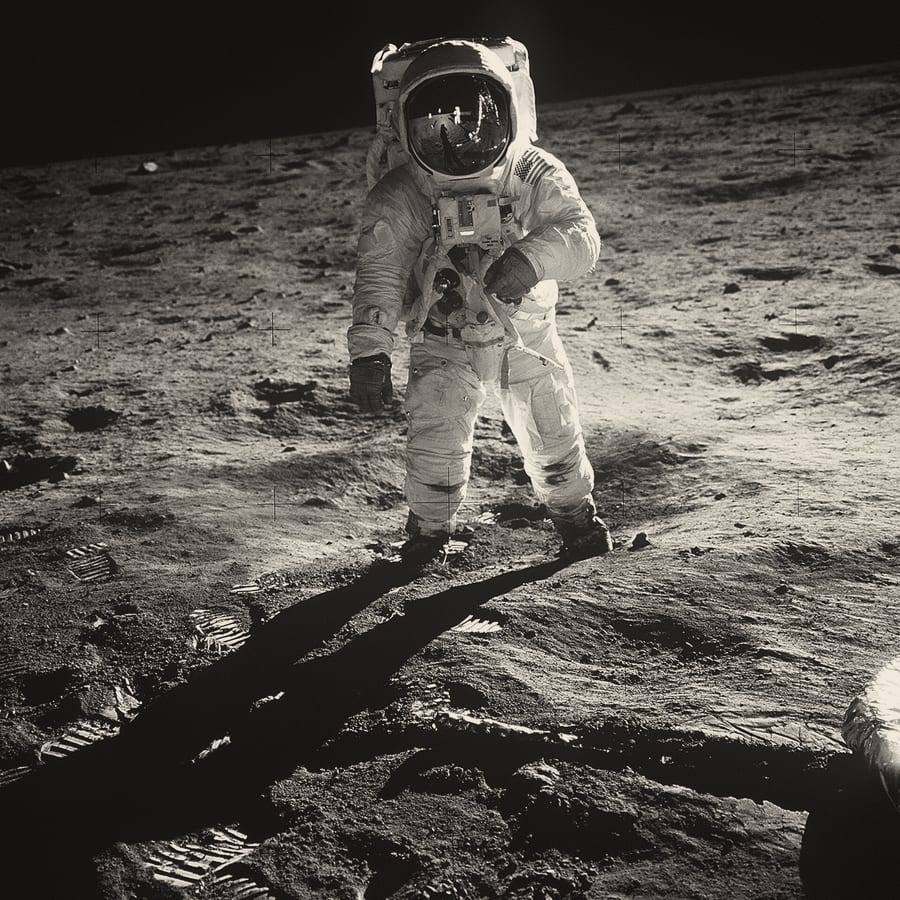
The computer that took them there held 2,048 words of erasable memory and 36,864 words of fixed. Sixteen bits to a word. Call it four kilobytes of working memory and seventy-two of program — less than the photograph above, by a wide margin.
And the fixed memory was not written so much as woven. Core rope: a wire threaded through a magnetic ring for a one and around it for a zero, done by hand, half a mile of wire to a rope. The software that flew to the Moon was a textile.
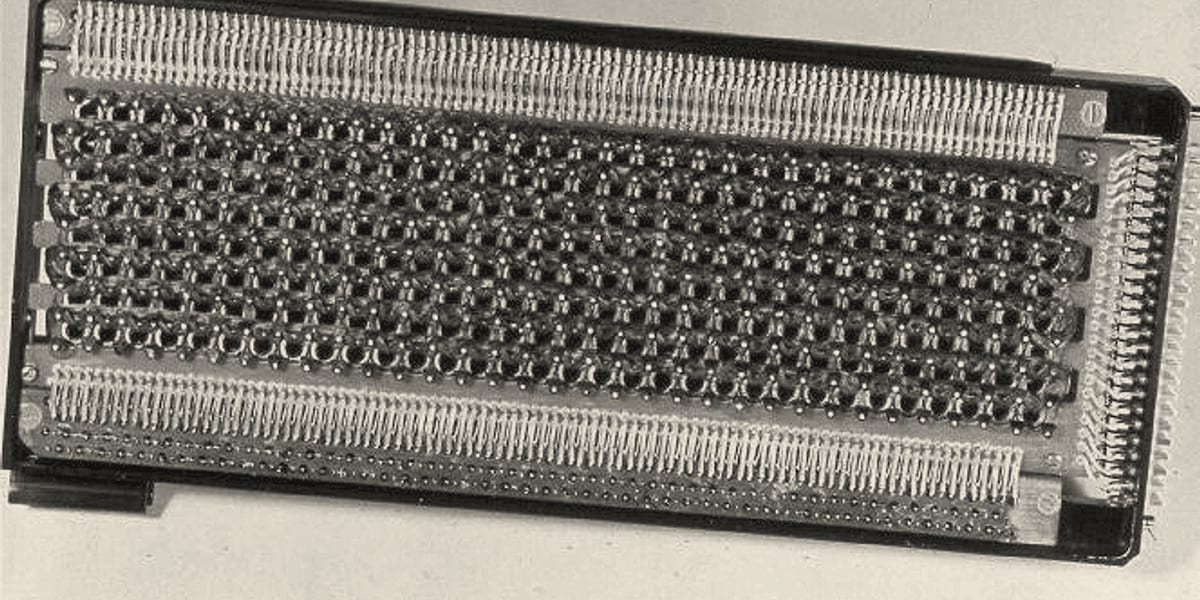
It was enough. Getting from the Earth to the Moon is exactly the kind of problem the Dartmouth proposal put on its list: precisely described, reducible to symbols and rules, executable step by step. Four kilobytes did it.
Then, in the last minutes of the descent, the computer began throwing alarms. 1202 — executive overflow, more tasks in a cycle than it could finish. Five came in all, four 1202s and a 1201. Margaret Hamilton’s team had built the executive to shed low-priority work and keep the landing running, and it did exactly that, which is why anyone landed at all.
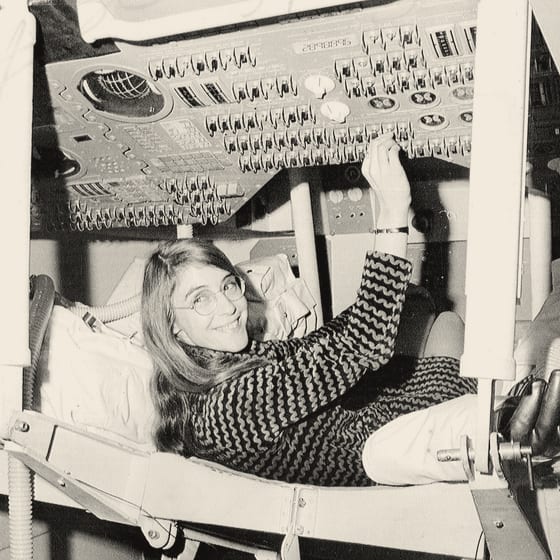
But the alarms are not the part that matters here.
The part that matters is that Armstrong looked out of the window.
The automatic descent was carrying them into the boulder field around West Crater. No alarm fired for that. Nothing in four kilobytes had any way to know, because the computer could not see. So a man took semi-manual control, flew west across the surface hunting for somewhere flat, and set it down with — depending on whose reconstruction you take — somewhere between twenty-five and forty-five seconds of fuel left.
Hold that against the list one more time. In 1969 a machine could compute a path from one world to another in four kilobytes of memory woven out of wire. It could not look at the ground and tell a rock from a flat place. That is Moravec’s paradox, demonstrated on the Moon, nineteen years before he wrote it down.
We got to the Moon before we could build something that could recognise a chair.
The cut is the mistake
Which brings the last leg back around, and I did not expect it to.
The image this walk started from is Kubrick’s: a bone goes up, a satellite comes down, and everything between is skipped in a single frame. I read it then as a picture of how fast we got here.
It is also a picture of the error. The bone is the sensorimotor half — a hand, a grip, an arm that knows how hard to throw. A billion years of it. The satellite is the reasoning half, the thin new veneer, four thousand years old at the outside. The cut goes straight from one to the other and skips everything in between, and skipping everything in between is precisely what Dartmouth did.
The most famous edit in cinema is a match cut that misses the hard part. So was the founding document of artificial intelligence.
And the timing is almost too good. 2001 opened in 1968 — the year before Apollo 11 — and put on screen a machine that could see, argue, read lips and lie. The computer that actually went to the Moon twelve months later had four kilobytes and could not tell a boulder from a landing site. The film, the cut, and the proposal all make the same mistake, and it is the same mistake every time: they skip the part that took a billion years.
The bill arrives
It took about seventeen years for anyone to say so in public with money attached.
They were not quiet years. Between the proposal and the bill sits an entire boom: programs that proved theorems, played a decent game, held conversations of a sort, moved blocks around a table when you asked them to. Some of it was genuinely astonishing and some of it was oversold by the people who built it, and sorting out which was which is the next leg of this walk, not this one. What matters here is only how the period ended, and who ended it.
In July 1972 the British Science Research Council received a survey it had commissioned from Sir James Lighthill — Lucasian Professor of Mathematics at Cambridge, a fluid dynamicist, and pointedly not an AI researcher. It was published in early 1973 as Artificial Intelligence: A General Survey, and its verdict was flat:
In no part of the field have the discoveries made so far produced the major impact that was then promised.
His central technical charge was combinatorial explosion: the methods worked on toy problems and died on real ones, because the number of possibilities to search grew exponentially with the size of the problem. A system that plays a tidy game on a small board does not scale into a world.
Within months the SRC cut AI funding at every British university but two. American funders drew the same conclusion — the Mansfield Amendment had already required DARPA’s research to show direct military relevance — and by the mid-1970s the money had gone on both sides of the Atlantic. The first AI winter.
Where this leaves the walk
So: not wrong about the machine. Wrong about the shape of the problem, in a way that took a generation and a funding collapse to make visible.
Which raises the question the next leg has to take, and I don’t have it yet. If reasoning is the thin veneer and perception is the deep old thing — how did we end up with machines that do the deep old thing at all? Nobody hand-wrote their way to seeing. Something else happened.
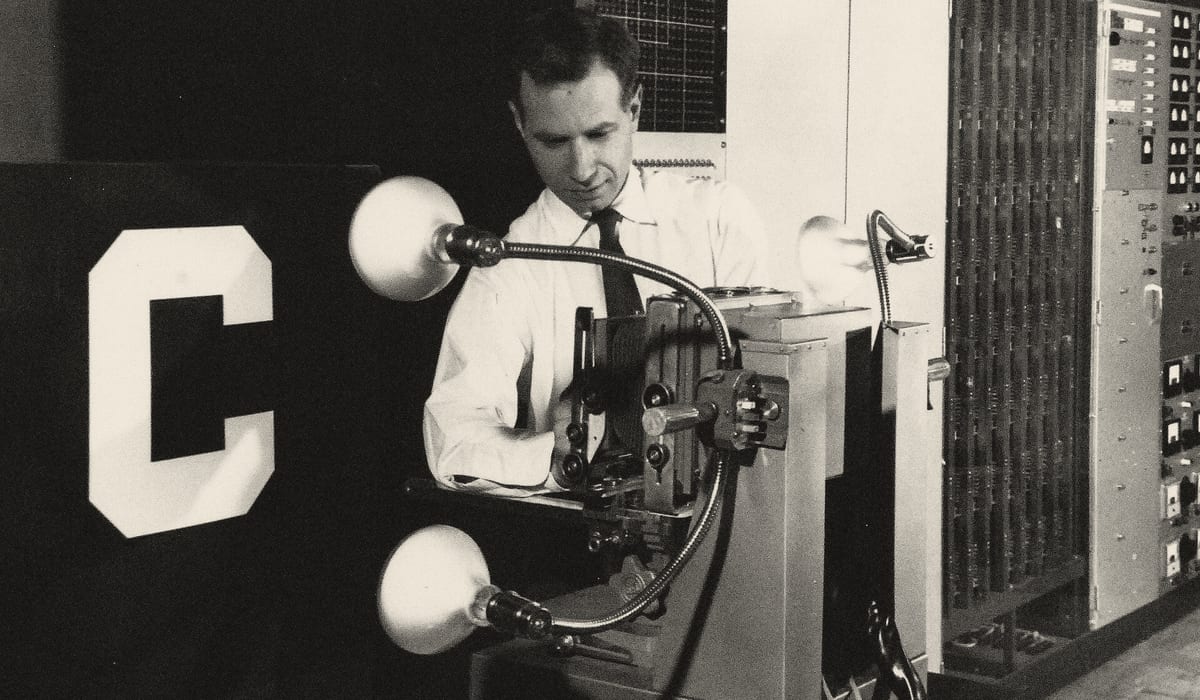
That something was on their list the whole time. Item three, Neuron Nets — in 1955 a single short paragraph asking how a set of hypothetical neurons might be arranged so as to form concepts.
It is worth saying when the gap actually closed, because the number is the argument. Machines became reliably good at looking at a photograph and saying what is in it in 2012, when a network called AlexNet cut the error rate on a large image benchmark from 26% to 15% and the whole field turned inside a year.
Fifty-seven years after the proposal. Forty-three after the Moon.
They had asked for two months.
They wrote the answer into their own document and had no way to know it was the answer — and neither did anyone else, for fifty-seven years, two winters and a great deal of stubbornness.
Which is where this walk goes next — by way of the seventeen years I have just skipped, because the answer was sitting in the middle of them the whole time, being built and argued over and, eventually, buried.