Leg 03of a walk with no known length
Item Three
The seventeen years the last leg skipped: what they actually built, what they oversold, and the idea that got buried by one of the men who asked for it.
Written 11 September 2026
Last time I left seventeen years on the floor.
The Dartmouth proposal was signed in August 1955. The report that pulled the money arrived in 1972. In between, I said, sat an entire boom — and then I walked straight past it to talk about the bill.
This is the boom.
The thing that worked immediately
The demonstration that actually landed at Dartmouth wasn’t a plan. It was a running program, and it had been finished before the meeting began.
Allen Newell, Herbert Simon and Cliff Shaw had built a thing called the Logic Theorist. You gave it the axioms of Whitehead and Russell’s Principia Mathematica and it went looking for proofs, and it found them — thirty-eight of the first fifty-two theorems in chapter two.
For theorem 2.85 it did something better than that. It found a proof shorter and cleaner than the one Whitehead and Russell had worked out by hand.
Newell and Simon tried to publish it. The Journal of Symbolic Logic said no.
Why it said no is the part where the accounts part company. One version has the editors deciding that a new proof of an elementary theorem simply wasn’t notable — apparently without registering that one of the authors was a machine. Another has them declining to print anything co-authored by a computer at all. I could not settle which, and I would rather leave the two versions standing than pick the one that reads better.
Either way the machine’s first publishable result went unpublished, and the symbolic programme was away.
And it kept working
Through the sixties the list got longer. Programs that played a decent game. Programs that proved theorems in geometry. A program that held a conversation convincing enough that people confided in it, and another that would move coloured blocks around a table when you told it to, and answer questions about why it had.
Read the Dartmouth list again and it is all there: language, abstraction, logic, calculation. They said a carefully selected group could make significant advances on one or more of those problems in a summer. In a decade, they made significant advances on nearly all of them.
That is the part that gets forgotten when this period is written up as a failure. On its own terms it was going extremely well.
The other bet
Item three on the Dartmouth list was two hundred words about hypothetical neurons, and it was the item nobody at the meeting was working on.
Someone else was.
In 1957 Frank Rosenblatt — a psychologist at the Cornell Aeronautical Laboratory in Buffalo, thirty-two years old — described a machine built on the opposite principle. Not rules written down by a person, but a network of simple units with adjustable connections between them, shown examples, and corrected when it got them wrong. You did not program it. You trained it.
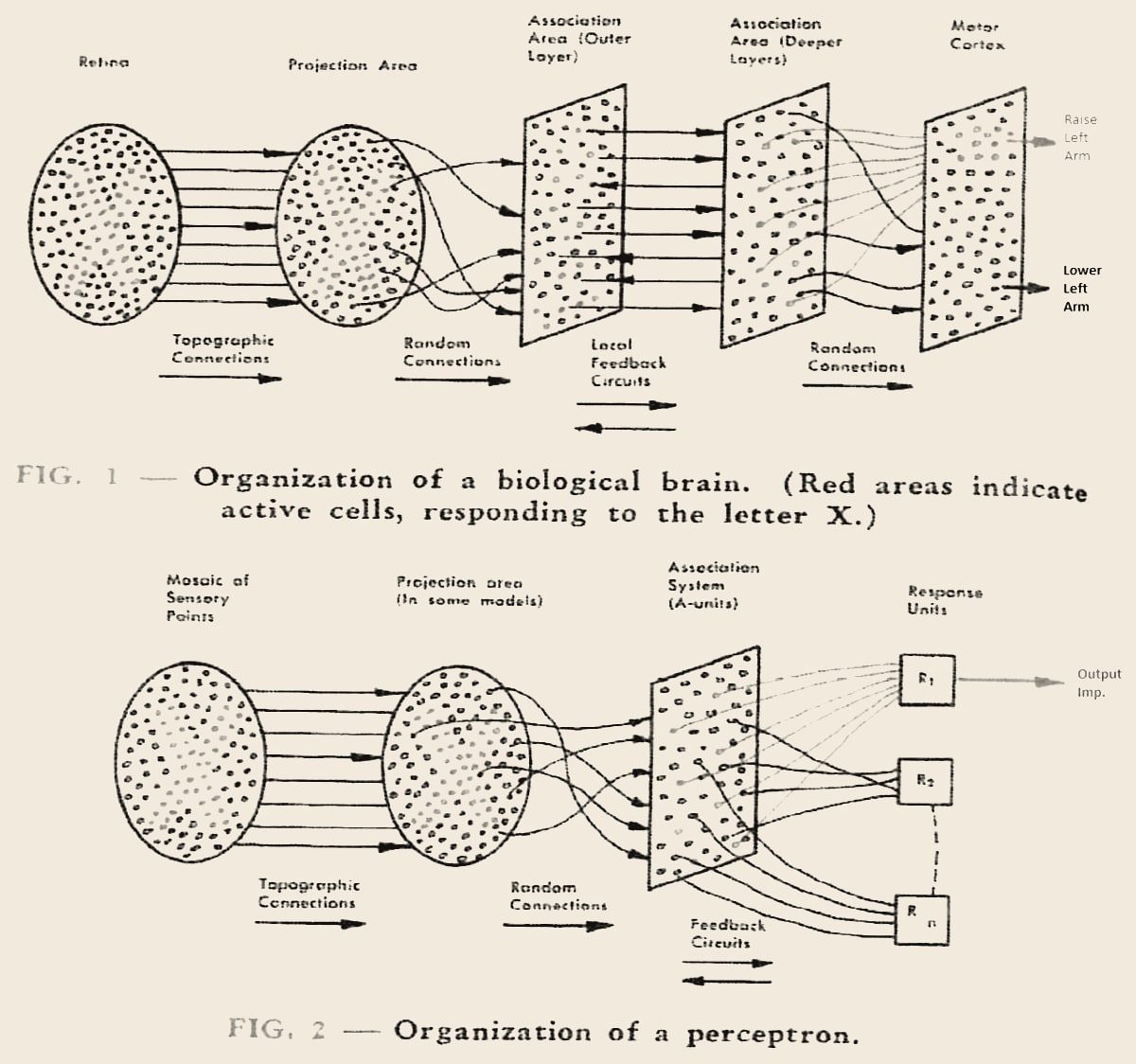
He called it a perceptron, and the plate at the top of this page is his own drawing of the idea: a brain above, his machine below, laid out deliberately to the same plan.
The Navy paid for it. In July 1958 the Navy also held a press conference, and that is where this story starts going wrong.
The Navy revealed the embryo of an electronic computer today that it expects will be able to walk, talk, see, write, reproduce itself and be conscious of its existence.
That is the New York Times, 8 July 1958, under the headline NEW NAVY DEVICE LEARNS BY DOING.
The actual machine could be trained to tell one letter of the alphabet from another. That is a genuinely remarkable thing for a machine to do in 1958 — it is the thing Dartmouth had not thought to ask for — and it is not walking, talking, reproducing itself, or being conscious of anything.
The gap between those two paragraphs is the whole problem with this period, and it was not really Rosenblatt’s gap. It was the gap between what a laboratory can demonstrate and what a press conference can be made to say.
The book
In 1969 Marvin Minsky and Seymour Papert published Perceptrons.
Minsky is the M. L. Minsky of Harvard who signed the 1955 proposal. He is one of the four men who put neuron nets on the list as item three. He and Rosenblatt had known each other since school — a year apart at Bronx Science, Minsky the year below.
The book is mathematics, and the mathematics is correct. What it proves is that a perceptron of a single layer can only separate categories that a straight line can separate.
XOR is the standard example: true when one input is true, false when both are or neither is. Put the four cases on a grid and the answers sit at opposite corners. There is no straight line. There is no clever straight line. A single-layer perceptron cannot learn it, and no amount of training will help, because the thing being asked for does not exist.
That result is not in dispute and never has been. It is a proof.
What is in dispute
What Perceptrons is remembered for is bigger than what it proved. The remembered version is that Minsky and Papert killed neural networks — that the book emptied the funding, cleared the field, and put the whole idea in a drawer for fifteen years.
I want to be careful here, because that story is repeated everywhere and disputed by people who have actually gone back through the record.
What is fair to say: the proof applies to one layer. Stacking layers escapes it, and Minsky and Papert knew that, and they guessed — wrongly — that the same kind of limitation would turn up in the layered case too. That guess was in a book by the most prominent man in the field, and it was not corrected for a long time.
What is not fair to say is that a book did all of it on its own. Money was already tightening. Nobody yet had a practical way to train a layered network even if they had been certain it would work. And the man whose work it was would not be there to argue.
Two years later
Frank Rosenblatt died on 11 July 1971, in a boating accident on Chesapeake Bay. It was his forty-third birthday.
He did not see any of it — not the method that would train the layered networks he had guessed at, not the machines that would eventually do the thing the press conference had promised on his behalf thirteen years early.
The idea he had backed sat in a drawer for most of two decades.
Where this leaves the walk
So the seventeen years were not empty and they were not a failure. They were a field getting extremely good at the half of the problem it had chosen, while the other half sat in item three with almost nobody working on it, oversold in a newspaper, and then closed down by a proof about a limitation that stacking layers would have escaped.
Which leaves the obvious question, and it is the one the next leg has to answer. If layers were the way out, and people knew layers were the way out — what took fifteen years?
The answer is not a discovery. It is a piece of arithmetic nobody could do fast enough, and a few people who kept going anyway.