Leg 01of a walk with no known length
Bone to Satellite
Before the neural nets, a walk back to the people who first thought a machine might be able to reason at all.
Written 23 August 2026
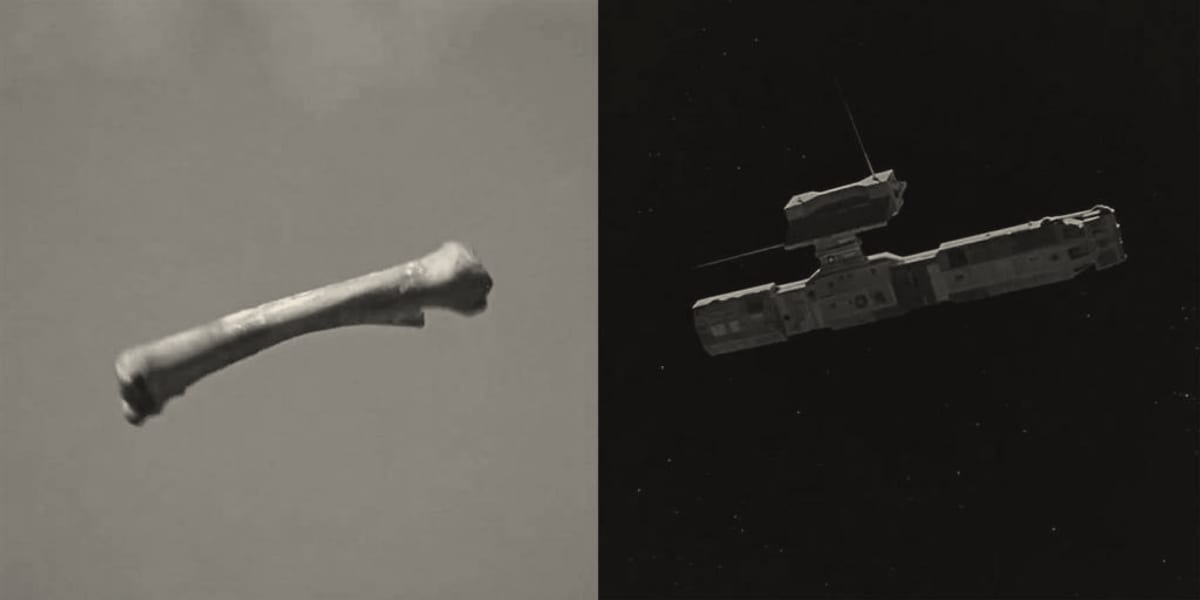
I was scrolling through Instagram a couple of days back and came across that iconic scene from 2001: A Space Odyssey. The one everyone means when they say bone to satellite — an ape works out that a bone can be a weapon, throws it spinning into the air, and Kubrick cuts mid-arc to a machine in orbit. Millions of years crossed in a single frame. Sticks and stones, to the ingenuity of putting something above the atmosphere.
It has an uncanny resemblance to the moment we are going through right now. I’m talking about the one who must not be named. AI.
So how did we get here? How did we end up with models big enough that nobody outside the labs that built them knows quite how big — trying to mimic a brain, not managing it yet, and closing the distance anyway?
The easy answer is Moore’s law. It’s worth actually reading what Moore said, because most people who quote him haven’t.
In April 1965, Gordon Moore was head of R&D at Fairchild Semiconductor. He had five data points, one a year from 1959, for how many components you could put on a chip at the lowest cost per component. He drew a line through them, published it in Electronics, and wrote this:
The complexity for minimum component costs has increased at a rate of roughly a factor of two per year.
That’s it. That’s the law. A doubling every twelve months, observed across five years and projected forward for ten — he thought a single chip might hold 65,000 components by 1975. In 1975 he came back and revised it himself, slowing the forecast to a doubling roughly every two years. He never called it a law, either. Carver Mead did that.
Sixty years of that compounding is how you get from a room full of vacuum tubes to the phone I read that Instagram post on. Whether it is also how you get to a model with a trillion parameters is a harder question, and not one I can settle in a first post. Set it down for now.
Because before any of that — before neural nets, weights, backpropagation, generative transformers, monosemanticity and the rest of the vocabulary that arrived with them — we need to go back. Further back than the chips. Back toward sticks and stones, and ask the actual question: why ai?
Humans are a product of iterative execution: the things we do daily, done again and again until they change into something else. Every one of them started as either a coincidence or a deliberate effort to answer why. Discovering fire. Inventing communication, trade, all of it.
So at what point did we decide to build mechanisms that could mimic human thinking — or at least human action? Turns out the answer isn’t what people think it is. You’d guess the 1950s, because that’s roughly when the term started being thrown around. But it started way back. Way back. I’m talking 1600s.
Surely you didn’t think nobody had considered making their life easier by having something — animate, not human — do the work for them.
-
1600s
The seed idea
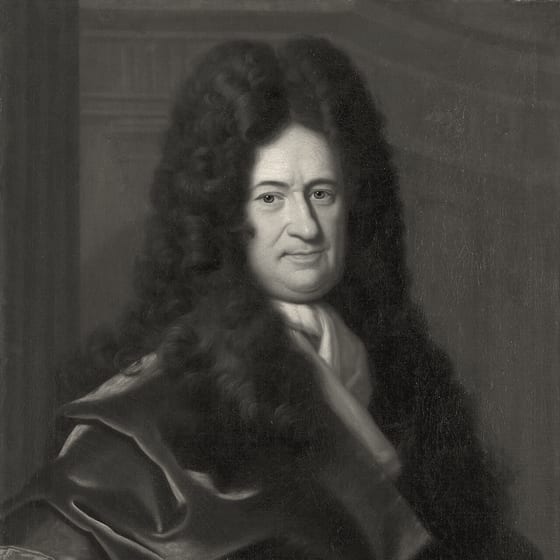
Gottfried Wilhelm Leibniz, painted by Christoph Bernhard Francke, c. 1695. Gottfried Leibniz imagined a characteristica universalis: a universal symbolic language in which any logical problem could be settled mechanically, the way an arithmetic problem is settled. Reduce reasoning to symbols and rules, and a machine could carry it out.
Nobody could build such a thing, and that isn't the point. The point is that the idea was already sitting there in the 1600s, three centuries before anything existed that could run it.
-
1800s
It becomes plausible
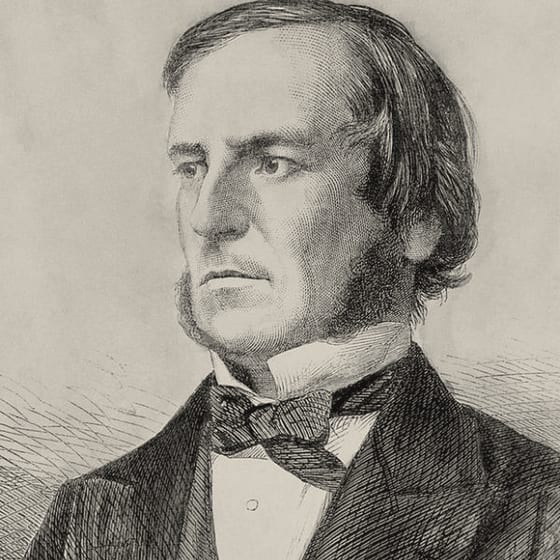
George Boole. An Investigation of the Laws of Thought, 1854. George Boole published An Investigation of the Laws of Thought in 1854, showing that logical reasoning could be written as mathematical equations — true and false, and, or, not. Suddenly it seemed less magical and more mechanical.
Boole thought he was describing how people think. He was also, without knowing it, describing how every computer built since would be wired.
-
Early 1900s
The mathematical proof
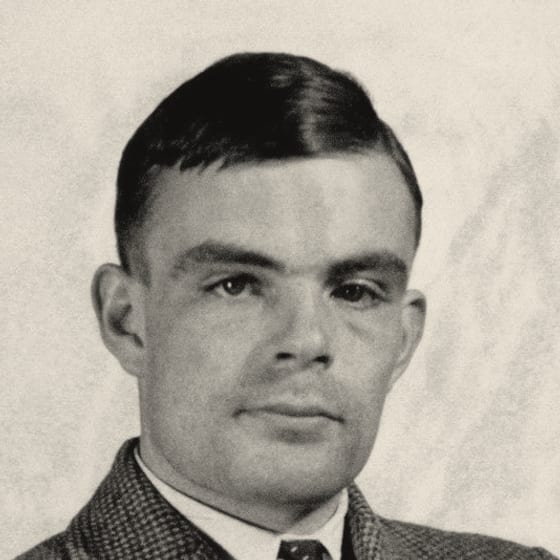
Alan Turing at Princeton, 1936 — the year of On Computable Numbers. In 1931 Kurt Gödel proved that any formal system rich enough to describe arithmetic contains true statements it cannot prove. A limit on what proof itself can reach.
Then in 1936, Alan Turing did something stranger: he defined what it means to compute at all. An imaginary machine — a tape, a head, a table of rules — and a demonstration that anything solvable by following steps is solvable by that machine.
That is the huge part, and it's worth being precise about why. Not that machines could calculate; adding machines had done that for centuries. It's that any step-by-step procedure could be carried out by one general machine. Which means that if reasoning could be reduced to steps, reasoning could be automated. In principle.
-
1940s
We have the machine
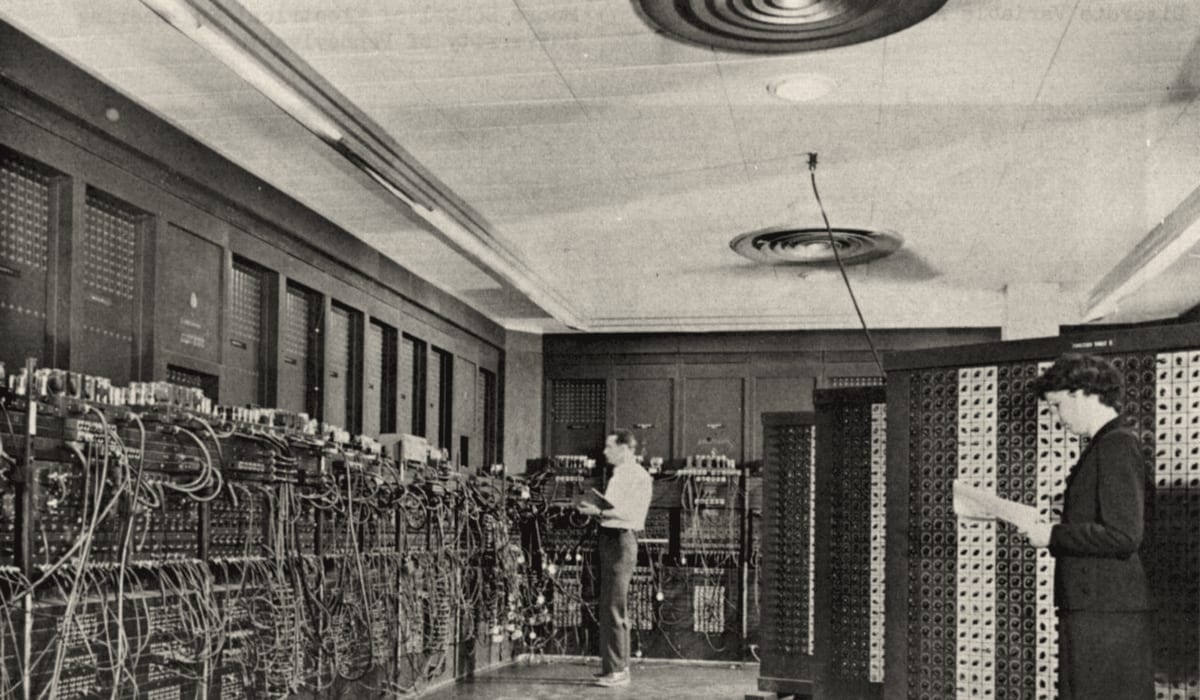
Glen Beck and Betty Snyder programming the ENIAC at the Ballistic Research Laboratory. Snyder was one of the six women who programmed the machine. Then the machines actually arrived. ENIAC and its contemporaries: rooms of cabinets, cable and switch panels, powerful enough to do mathematics nobody had the patience for.
Researchers looked at them and thought the obvious thing. We finally have the tool. Turing's theory says it's possible. Let's actually try to build reasoning machines.
-
1950s
Let's do it
On 31 August 1955, four researchers — John McCarthy, Marvin Minsky, Nathaniel Rochester and Claude Shannon — wrote a proposal for a summer workshop at Dartmouth College. That document is the first time the phrase artificial intelligence appears in print. The workshop ran for about eight weeks from 18 June 1956.
The people in that room genuinely believed a machine that reasoned like a human was a generation away. At most.
So the narrative runs clean. Symbol-based reasoning, proven mathematically possible, the machines finally exist — so let’s build it.
Which is exactly the kind of story I’ve learned to be suspicious of. Every step in it is true, and the line drawn between them is far too straight. They were wrong about the generation, and badly wrong. Working out why they were wrong is where this walk goes next.